Showing posts with label Ocean conservation. Show all posts

Sunday, November 2, 2014

BiondoBags


Another one of the projects I've been up to lately. These are shopping bags, or totes if you will. They are made of laminated cotton, are extremely lightweight, and can fold up and be tucked in a purse or pocket.  Easy to keep in the map pocket of the driver's door in the car.  There is a three inch pleat on each side making them expandable for groceries or several items of new clothes.  They can carry a lot of weight. I've recently toted home two half gallons of milk in glass bottles along with four glass bottles of root beer (brewed locally I might add), in a single bag along with a loaf of bread and a few vegetables.  I happened to only have had one bag with me at the time.  They are washable.  They make nice gift bags too.


I make them in several ocean related prints (the one at top I consider "beach umbrellas").


Each and every one is designed and made by me.  They'll be on sale at the Monterey Bay Aquarium Craft Fair on November 16.

In bocca al lupo.  m (no v)

Sunday, September 28, 2014

School in Session


A group of fish do not expect other fish to pick up after them.  We have a lot to learn.

In bocca al lupo  m (no v)

Sunday, July 27, 2014

How Can I Help?


How does ocean acidification effect shellfish?  As the pH of the oceans decreases with the huge amounts of CO2 that are dumped into them daily carbonates are less available.  Carbonates are what shellfish rely on to develop their shells, without it the shells become thinner, growth slows, and the animals die.

How can we help??? Stop blaming and start changing...just a little at a time.

Turn off the lights
Buy less plastic, period.

Consider quality over quantity--more is definitely not better.
Have a weekly evening of reading or conversation instead of TV or video games

Encourage your children to put on their own theater productions for you and your friends
Gather together for potluck evenings
Support Farmers' Markets and buy produce grown locally and in season
Make do and mend--that's an old saying from the days of rationing, but why not be creative?
Go to the library
Play in the park
Use reusable (and washable) bags for shopping
Walk to our destinations whenever we can, or
Ride a bike to school, the market, work (if possible).
Share rides.
Demand better public transportation! Two hour commutes of only a few miles is not encouraging people to "ride the bus"!
Support Light and High Speed Rail development.

Just a few thoughts, please add your own.

In bocca al lupo.  m (no v)

Friday, May 9, 2014

Life on Earth


Chambered Nautilus.


This is what I love about looking at the surface of the sea...imagining what might be just below the surface and beyond.  It's all so very precious and so very vulnerable, as are we all. What can we do to protect them and ultimately ourselves?

In bocca al lupo.  m (no v)


Sunday, February 2, 2014

"Pride Goeth Before a Fall"


Oh this saga could not go on for long without some calamity (large or small) occurring.  This morning one occurred.  v decided he'd had enough of being waited on and decided to get up on his own.  We don't have Lassie, but we have a small cat named Emily who came trotting, with purpose, from the bedroom area just as I heard a shout.  If you don't know us personally (and I believe most who read this do) you should know that v is not a big man, not in stature that is.  Thank God for that.  He's back to bed, he's caught his breath, and he is uninjured and neither am I. They do say "Pride goeth before a fall"...my, my...

This weekend v's daughter has been down from Portland where she lives, works, and goes to school.  He has been a happy man having his beautiful daughter here beside him.  It's been good to have the late night company for me.  It has also been nice for me, aside from the company she provides, that she is also far more techno savvy than I am. She has fixed a few of the glitches I've somehow created with my Mac and taught me about some convenient settings.  Sadly, she leaves this afternoon (though, last evening, v was oddly more concerned with whether I'd be able to set him up to watch the Super Bowl), but we're working on getting her back soon.   A quick reminder that the 49er's lost made the need for a sick room man-cave less urgent.  Sheesh! life goes on even if it requires more external support. Thankfully, the game streams live on-line (at least, it did last year).

Our friend Father Bill came by again yesterday to give v communion and read to us from a book called "Psalms for Praying" by Nan Merrill.  It's a new translation and more contemporary interpretation of the psalms. As he read from one that sounded familiar (but do I know it???) a passage about polluting the seas came up that I thought would be particularly appropriate for the aquarium and the message of conservation of the oceans and marine life. It actually read "you have polluted the seas" and God doesn't like it! A major influence, wouldn't you say?

In bocca al lupo.  m & v


Friday, June 28, 2013

Preview


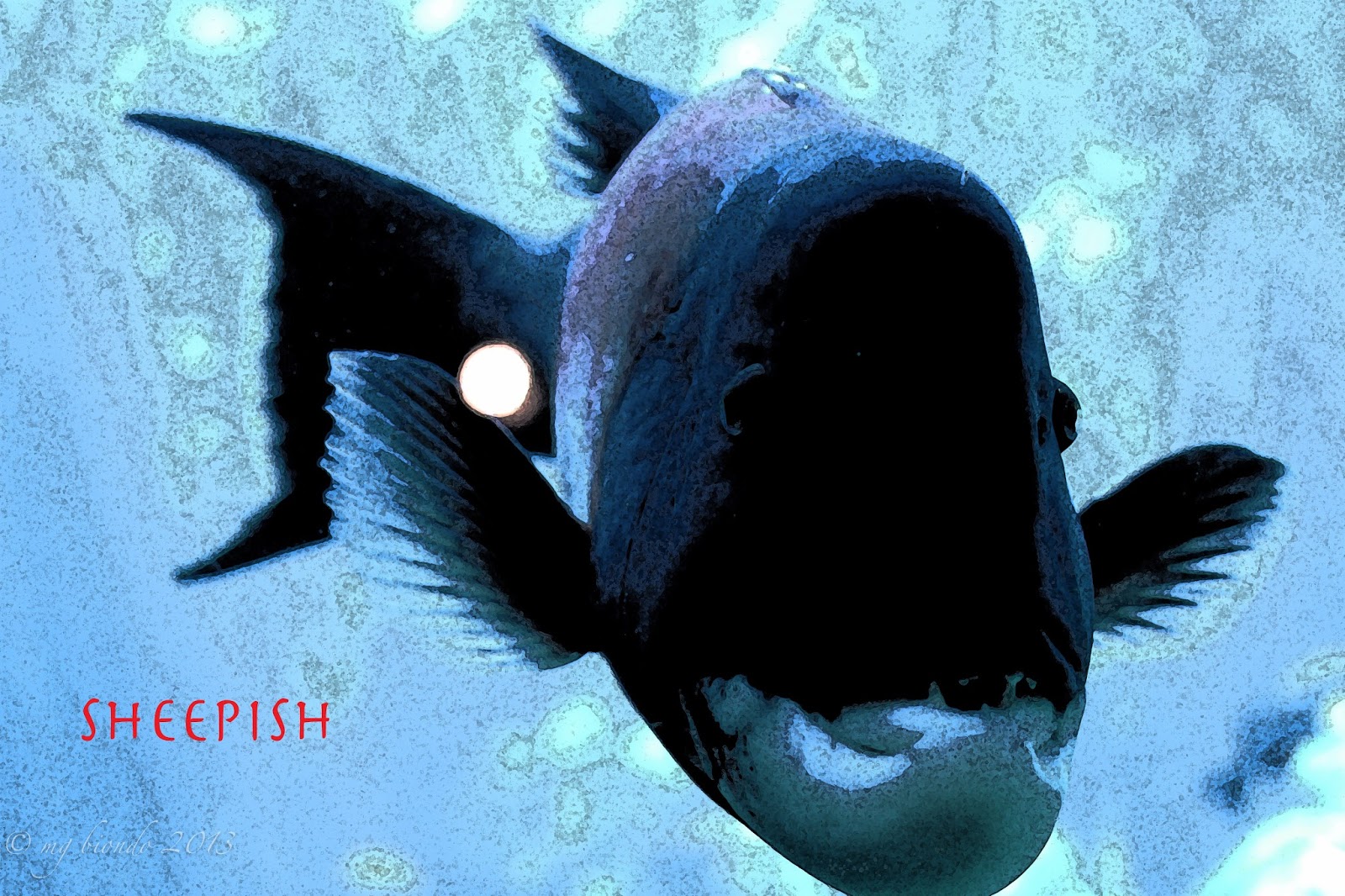
We're starting a new venture utilizing the Photoshop Elements I received as a gift from one of our very dear friends.  The sunflower sea star is one of my first models. My second model, the male sheephead, just isn't making the cut.  I loved that he came up to the glass as if to greet my friend and I as we toured around the Monterey Bay Aquarium.


He's a beautiful fish, and a crowd favorite.  There will be more on this venture in the next week or so.  It depends on the outcome at the printer's.  We are starting with five designs.  Is anyone curious?

In bocca al lupo.  m & v


Saturday, January 19, 2013

Think About It


If a man walks in the woods for love of them half of each day, he is in danger of being regarded a loafer. But if he spends his days as a speculator, shearing off those woods and making the earth bald before her time, he is deemed an industrious and enterprising citizen.               Henry David Thoreau

We are too quick to clear the land and cover it with asphalt in order to park a car on it for several hours a day.  Our taxes support this.  It is the infrastructure.  We clear acres and acres of space for new, and frequently poorly constructed, new homes while older homes nearer city and town centers are allowed to deteriorate, to become "low-income" rentals that landlords feel little obligation to maintain beyond basic standards.  We have no pride.  

We've been convinced that "growth" for our economy relies on more and more new homes to congest our landscape, distance us, isolate us, and enslave us to the wasting of fossil fuels to return to our ever more distant jobs.  On your way home from work make an observation as to how many large automobiles are single occupant.  Why do we drive in a vehicle larger than the covered wagons that moved entire families westward?  How many of the Conestoga's were private vehicles?  Mom and Dad with separate wagons? The teenager gifted his or her own by virtue of living to the age of 16?  Two to four wagons per family?

We should insist that our tax dollars be spent in the upkeep of existing residences and buildings.  Architects, contractors, carpenters, plumbers, all journeymen would be just as busily employed with remodeling, upgrading, and redesigning.  Instead of more roads let's build an efficient high speed rail system.  Make public transportation practical.  Give us the opportunity to walk or bike to work and the markets.  Free up space and give us some air.

How can we and our county and state governments condone the construction of new shopping centers and malls while so many storefronts are empty and have been since the crash of '08 and before?

Stop moving away and move toward.

In bocca al lupo.  m & v


Monday, September 17, 2012

Sea Otters


From 1741 to 1911 sea otters were hunted so heavily by Russian and Yankee fur traders that they were thought to be extinct along the California coast. However, sometime in 1911 a small population of 50 sea otters was rediscovered along the Big Sur coast.  Luckily the sea otter became protected by the International Fur Seal Treaty in 1911 and by the State of California in 1913.

A sea otter is kept warm only by it's fur coat.  They have no blubber to keep them warm like whales, seals and other mammals living in the sea.  The sea otter's fur consists of millions of tiny hairs, over 400,000 per square inch, which must be kept clean. Sea otters spend hours every day grooming their coats trapping air within the hairs which provides insulation much like a wetsuit provides insulation for divers and surfers.  If  an otter can't keep its fur clean it will die from exposure.

Before the sea otter was reintroduced into the Monterey Bay in 1963 the kelp forest had been devastated by unchecked populations of sea urchin and abalone. The abundant sea life we enjoy in our bay was only a small fraction of what we have today.  Sea otters play an important role in maintaining the balance of sea life in the bay.  That said, not all sea otters eat abalone, and not all eat sea urchins.  It's been found that sea otters learn to eat whatever diet their mothers enjoyed, much like humans tend to gravitate to the flavors they grew accustomed to as children.  Their diet consists of mostly invertebrates including mussels, clams, snails, squids, octopuses, crabs, sea stars, and more.  Some are opportunistic and will just feed on whatever is available, but studies find that many stay within the "mother preference" diet.

The southern sea otter is a threatened and endangered animal.

SORAC (Sea Otter Research and Conservation) is a program established by the Monterey Bay Aquarium in 1984 to study and try to save the southern sea otter. To date 540 stranded sea otters have entered  into the program.  As much as possible the animals are rehabbed and released back into the wild. Sometimes their injuries leave them too vulnerable and they are either kept on exhibit at the Monterey Bay Aquarium or they are adopted by another aquarium or zoo.

Currently the sea otter exhibit at the Monterey Bay Aquarium is undergoing renovations and will be closed until March 2013. In the meantime there is a great new station set up on the aquarium's deck allowing people to observe and learn more about the otters in the wild, many of whom are tracked by SORAC.  Recently one of the sea otters who was a successful rescue and has been reintroduced to the wild, was observed paddling by on her back, very close to the deck, with her new pup resting on her stomach.

It is important to remember that as cute as the sea otters are they are still wild animals with very sharp teeth.  Kayakers, boaters, and others out on the bay, or the ocean, need to keep a distance from the animals of 100 feet, or more, for their own protection as well as that of the animals.

For more information on SORAC and sea otters please click the link to the Monterey Bay Aquarium at the side of this blog.

In bocca al lupo.  m & v


Sunday, August 19, 2012

A Question

Do you know what this is?

Tuesday, August 14, 2012

Market Day

It's Tuesday.  We have spent our day at the Monterey Bay Aquarium introducing people to sea stars, hermit crabs, sea cucumbers, and gumboot chitons.  We've helped people find our giant octopuses, pointed out wolf eels, and encouraged one and all to limit their use of plastics, especially single use plastic items.  Witnessing the wonder alighting the faces of all ages and cultures is an unending joy for us. 

Tuesdays aren't just about the aquarium, however.  Tuesday is market day in downtown old Monterey. We hop on the trolley and take a short ride to the wharf where we take a short walk through beautiful gardens and past old adobes to Alvarado Street where the farmers' market is in full swing.


In the early days of Monterey, during the colonial period, men would sit on the balcony above this courtyard and watch Grizzly bears battle with bulls.


It's just a short walk away from the walls of this garden and past the Portola Plaza Hotel


to the beginning of the market.  The market can speak for itself.


From end to end we are surrounded by the adobes of old Monterey.


As they say at the market: Buy Fresh! By Local!  The number one best thing you can do to reduce your carbon footprint (and that of your food) is to buy local product.  Cuts down on shipping and the energy used to keep vegetables cool.  Reduces packaging as well.

In bocca al lupo. m & v

Tuesday, July 17, 2012

Variations on a Theme


This is a photo of a gray whale skeleton at the Monterey Bay Aquarium.  Whales are mammals, as are we. They breathe the air, have a bony skeleton, and give live birth among other things we have in common.


Be it evolution or creation the similarities are astounding to us.  Look at the pectoral fin on this skeleton. For the uninitiated that would be what appears as an arm.  Alive we would see a flat paddle shaped appendage, but look at this skeleton.  Do you see the fingers? Fingers on a whale?


Another view.  There's a scapula.  They have ribs and a spinal column, very much like our own. If you look very carefully and see the tiny triangular shaped bone hanging just below the last ribs you are looking at the vestige of a pelvic bone (and there are two).  


We mammals are like works of art created in an artists' workshop. The Instructor brought out a basic skeleton and asked the class of talented artists to create variations on the same theme. Each varied skeleton was then decorated to each artist's preference. Some mammals are furry while others are "naked as a jaybird". Take off our wrappings and we all have parts that correspond to the parts in every other mammal out there.
V says to me: "we are all related".  Looking at skeletons makes me believe.


In bocca al lupo (another mammalian relative) m & v

Fog's End Distillery, Gonzales, Ca.

Our neighbor has a distillery in Gonzales which is toward the southern end of Monterey County.  It's just a small town along Highway 101 established a hundred years, or so, ago by Swiss-Italians who found the region reminded them of their homeland in Northern Italy.  They established farms and dairies and many are still in operation and continue to be family owned. It is Ag Country.


Craig, our neighbor, is a retired Deputy Sheriff.  He was young enough, when he retired, to begin a new career and he decided he'd become a distiller.  He is virtually the only distiller in Monterey County, his product line now includes five lables: California Moonshine, Monterey Rye, White Dog, Primo Agua Ardiente, and a kit called Fog's End Hand Craft Your Flavor which is sold with oak sticks to add to the bottle and age at whatever length of time the home crafter prefers.  


Fog's End Distillery is a one man show.  Craig does it all, the brewing, the distilling, the bottling, the sales and the marketing. He drives out of our neighborhood in the wee hours of the morning to be at the distillery by 3 a.m.  He puts in many 18 hour days, sometimes more. He is meticulous, surgery could 


be performed on the premises it is so clean.  V got involved when Craig got his idea for the kits. He needed the sticks cut to specific proportions and v's got a nice little woodworking studio just beyond the garden.

A year, or so, ago Craig was featured on a cable television show called Drinking Made Easy.  Business began taking off.  The kit was a hit! V was making sawdust and Craig was shipping cases.  So it has now evolved that v has taken on some of the sales and marketing. He has many connections with the restaurant trade in the area and is also well known in the theater community. His showmanship and natural Italian charm makes him a natural salesman.  

Aside from really wanting to see our friend and neighbor succeed, we are very excited that this is a local, artisanal,  product! Buying a Fog's End product reduces our carbon footprint on the Central Coast and all over California. Less carbon is dumped in the ocean.  How good is that?  If you see it please try it. Many area restaurants and bars are stocking it. Nepenthe and Post Ranch in Big Sur serve it, Mission Ranch in Carmel and the Clement Intercontinental Hotel in Monterey have it on their list as well. I'm excited that chefs are developing recipes using it. 

It's just nice to see such a mild mannered, soft spoken man like Craig, succeed. 

Thank you, Craig and v for letting me get in behind the scenes to take my pictures.


In bocca al lupo. m & v


Monday, July 2, 2012

Sanderling Saga

The Sanderlings.  They are related to sandpipers.  We see them here, on the Central Coast, mainly in the winter. They are the little birds frantically running away from encroaching waves only to chase the receding wave back across the sand.  In the summer they are in their nesting grounds, the Canadian tundra.


The Sanderlings have one of the longest migrations of any bird.  Some Sanderlings migrate as far south as Tierra del Fuego. They travel along the Atlantic coast from Canada. Returning north they follow the Pacific coastline of South, Central, and North America. Except for when they are in their breeding grounds of the tundra the Sanderlings will be found almost exclusively on beaches.  


The Sanderling populations have decreased dramatically in the past 30 to 40 years. Total population has decreased by as much as 80% since the 1970's.  One of the most important stops for the Sanderling along its southern route is the Delaware Bay where their main source of nutrition is horseshoe crab eggs. Due to increased harvest of horseshoe crabs their food supply has been drastically reduced. This is devastating for these birds who arrive nearly starved along the shores of  Delaware Bay each spring. Development of beachfront property and the draining of wetlands also have a critical effect on Sanderling populations.


All shorebirds are impacted by the loss of habitat and the contamination of water and food supplies by the over use of high nitrogen fertilizers and pesticides.  What may not seem as obvious is that the use of these fertilizers and pesticides in areas that aren't near the coast can still negatively impact shorebird populations.  Effected ground water seeps into streams and rivers which eventually empty into the oceans. 
We all can take the time to explore more eco-friendly options in home gardens and dispose of pesticides responsibly.  It really has to be us, there's not a lot of time left for passing on the responsibility.


In bocca al lupo.  m & v


Tuesday, June 26, 2012

A Day at the Aquarium


Today is our playday. We share the same shift at the Monterey Bay Aquarium. It's summer and there are thousands of people coming in everyday and they're coming from all over the world.  Sea Nettles.


Some of our visitors come to the area specifically to visit the aquarium. As v loves to say, it is truly a world class organization. The Central Coast has such an array of varying marine habitats and each is represented at the aquarium.  The research arm of the aquarium is MBARI, Monterey Bay Aquarium Research Institute. For some amazing video images go to www.mbari.org, or check them on YouTube.  Ocean Sunfish.


The mission of the Monterey Bay Aquarium is to inspire conservation of the oceans.  We find that our visitors are hungry to learn more about what they can do to forward that mission.  It is so heartening to hear from people from China, Russia, Germany, Chile, Tunisia, Israel, Great Britain, France, Mexico, Japan, Norway, and so many other countries tell us of their concerns, and what steps their own friends and countries are taking toward the conservation of our home, this planet.  Sheephead.


What we take away from meeting so many people from so many places is the joy of the diversity. Isn't it wonderful that we aren't all alike?  We all have different experiences and can look at the world each with our own unique perspectives.  Despite these differences the people who come through the doors of this aquarium share the love of this earth and the ocean, and the desire to learn more about the creatures under the sea.  Green Sea Turtle.

In upcoming posts we will tell you more about the animals featured today, and of others.  Care. Support. Conserve. We are all we have.

In bocca al lupo.  m & v


Saturday, June 23, 2012

The Neighbors

This is a nudibranch. He's related to the slugs in your garden, but he's so much prettier. All those projections on his back that look like a shag rug are his gills. Some nudibranchs eat, among other things, the tentacles off of sea anemones.  Embedded in the tentacles of sea anemones are stinging cells called nematocysts.  The same kind of stinging cells on jelly fish to whom sea anemones are related. The nudibranch is able to munch away on those tentacles without triggering them to fire so all those stinging cells end up stored in those frilly gills and can be used by the little sea slug. His bright color warns potential predators that he's more than a mouthful.


Tube anemones live on the sandy bottom. They create their own leathery tube that burrows deep into the seabed. Their tentacles extend over a foot as they gracefully collect plankton. Each tentacle will delicately curl in on itself as it floats back to the center to slip silkily through the shorter tentacles to slide its tiny meal into it's mouth.  When the tentacles are brushed by possible danger the anemone can pull in it's tentacles in the blink of an eye.  However, sometimes a hungry little nudibranch is able to hold on for the ride. The anemone isn't killed, but it returns to the water column with a slightly less graceful mane. V sees the witches from Macbeth in this group of tube anemones.

We don't see these animals unless we are divers or have the chance to visit an aquarium, in this instance; the Monterey Bay Aquarium.  There is unbelievable beauty beneath the crashing waves and the gentle swells. Life forms that have existed since before man first walked this earth are in danger not just from industrial pollution, but from you and me.  Our carelessness and our laziness.   When you visit your local coffee house to get together with your friends, ask for your coffee to be served in a "for here" mug. Many coffee houses will give you a discount for not using a paper cup. If you get a snack have it served on a plate and not in a paper bag.  And don't forget your re-useable shopping bags--and not just for groceries. 

Here's a secret: It's not just for them that we do it. It's for ourselves.  A world where not everything turns to trash.  Permanence.  Less clutter.  More air. More room. More life. Really. We promise.

In bocca al lupo. m & v


Thursday, June 21, 2012

Solstice

Summer begins.  Solstice from the Latin Sol for Sun,  sistere for stands still.  The longest day of the year in the Northern Hemisphere.  Winter begins down below, the shortest day of the year.


The United Nations Conference on Sustainable Development begins today in Rio de Janeiro. Among several topics they will be discussing are climate change and ocean conservancy. This conference is also referred to as Earth Summit.


Warning: the following is a rant


These conferences have been going on for decades, but what effect have they actually had on the well being of this planet and daily lifestyle changes? Acidification of the oceans continues to increase, every hour more than 2.4 million pounds of plastic trash is dumped into the ocean (in an earlier post I said daily, but I rechecked my resource).  People are still rolling flatbed carts out of big box stores filled with enough product to open a small shop of their own, to be hauled home in a vehicle the size of a covered wagon. Consuming is the national past-time.  How much of these purchases are packaged and then further wrapped in plastic? Where are all those rolls of toilet paper and cases of spaghetti sauce being stored? Is it truly economical to turn a home into a warehouse?  As garages are used to store excess stuff one of the most expensive investments (for most people) the automobile is left out in the driveway or the street to suffer the effects of exposure to sun and weather.  How is that being frugal?  I, so far, have not come across anyone who shops at one of these temples of economy who is shopping in a collective fashion, i.e., on behalf of themselves and a group of friends and/or neighbors. This would be understandable; a co-operative.  I'm sure some groups must be doing this.


We also need to continuously be aware of where the things we buy are coming from. Are we sustaining our local economy, our neighbors, ourselves?  


Make a small change: stop buying small bottles of water by the caseload. Use a re-useable bottle (preferably glass). If you must buy bottled water use bigger bottles to refill from.


In bocca al lupo. m & v

Thursday, June 7, 2012

Beach Breakfasts

Sometimes one of us will awaken just before daybreak and decide it would be a good day to pack our breakfast and take it to the beach, we stop at Starbucks for a coffee on the way.  The best times are when low tide coincides with this spur of the moment decision so we can do some exploring of tide pools.  
Other than some beach glass or broken shells, the best thing to take from a tide pool is a photograph. 
We always see the little hermit crabs.Hermit crabs don't make their own shells, you know.  They take advantage of abandoned shells, mostly those of the sea snails, and move in.  As they grow they crawl out of these shells and move into larger digs.  I've read that certain species of hermit crabs will form what is known as "vacancy chains".  A group of crabs will surround a vacant shell.  They'll line themselves up from largest to smallest and once the largest crab fits himself into the shell the next largest crab fits himself into the newly vacated shell and so on to the smallest crab in line.  Hermit crabs aide in keeping the water nice and clean and clear by scavenging dead animal and plant materials. Not much goes to waste.  The fact that they don't make their own shells is one good reason to limit the collection of intact shells. 

Another fact about the Monterey Bay and the Central Coast in summer: it's normally cold, damp, and foggy.  Summer is the Upwelling season when the winds blow on shore off the Pacific.  The force of the wind causes an upwelling of the cold, nutrient rich water from the bottom of the bay up to the surface. The current water temperature is 49 degrees F.  This is wonderful for the kelp and the marine animals living in the bay.  This is their bountiful time of the year. However, the cold air coming off the ocean hits the warm inland air creating a blanket of fog along the coast. This is sometimes disappointing for people visiting for the first time expecting to find the legendary sunny California beaches. That's generally south of us.  
This year we actually haven't had as much fog as usual, so far.  We even had a rainstorm the other day which is pretty much unheard of after the beginning of May.  So, it leaves me wondering if this is an unusual weather event, or further evidence of climate change?  In bocca al lupo. m & v

Tuesday, June 5, 2012

Tuesdays by the bay

On Tuesdays we volunteer at the Monterey Bay Aquarium. The aquarium's mission is to inspire conservation of the world's oceans.  We see thousands of people from all over the world come through this site and our hope and our goal is to instill that mission into their lives as well.  
The climate is changing and the oceans are warming and becoming more acidic.  Whether we live on the coast or mid-continent this will affect all of our lives and the lives of our descendants.  To view this problem globally is overwhelming to the majority of us. It leaves some of us feeling helpless and powerless. 
So, what can we do? Small changes. 
We chose our shift at the aquarium to coincide with the Tuesday farmers' market in downtown Monterey. It saves a trip into town.  We use our own re-useable bags at the market and for all of our shopping. We use re-useable mugs and water bottles. These are the little things that most people could do.
Make a change and encourage someone else to change as well.  One change at a time.In bocca al lupo.

Tuesday, May 29, 2012

Breath of Life


Do you realize that every other breath you take is a gift from the sea? During the process of photosynthesis oxygen is released from phytoplankton. It doesn't matter where you live.

Every day more than 2.4 million pounds of plastic trash is dumped into the sea, and most of it comes from the land.  When we head home after a day at the seashore we must take what we brought with us away. We can empower our children with the responsibility of cleaning up after themselves.

Plastic waste circles the globe via currents and massive gyres.  Plastic debris is mistaken for prey and eaten by fish, sea animals, and seabirds which can kill them.  Harmful chemicals leach from plastics floating in the oceans poisoning and killing sea life, including phytoplankton.

If breathing is precious to you use less plastic. Buy less plastic.  Re-use the items that you already have.

A growing number of communities world wide are banning the use of plastic bags. Sea turtles and other marine animals and birds don't know what a plastic bag is. The shape of a plastic bag signals "jelly fish" to them and they go after it. These animals and birds starve to death with bellies full of plastic.

Plastic mustn't be abolished. The use of plastics in medicine is essential. However, when we are checking out at the market the choice of "paper or plastic?" should no longer be offered. BYOB should now be Bring Your Own Bag.  m & v

Sunday, May 27, 2012

Happy Birthday

Today is my birthday and I've chosen these Polka Dot jellies to be my card to me.


They have no brain, blood, bones, or heart.  They are 95% seawater.  They are beautiful and many people fear them. It's that other 5%...  Their tentacles are loaded with stinging cells which, when stimulated can shoot out like a harpoon to stun their prey, then draw it back in for a meal. With the warming of the oceans the jelly fish aren't endangered, just the opposite; they are actually increasing in numbers.  They have negatively impacted coastal industries, including fishing, and when they arrive in large numbers at popular beaches they can drive people away.  So, what can we do to help? One thing would be to think more about how we buy our food. Is it local? Is it in season? Check the label and see where your food comes from.  Your food really shouldn't be logging more air miles than you do.  Read Barbara Kingsolver's book Animal, Vegetable, Miracle and when you go to buy your vegetables for the week, use a reusable bag. m & v